Compare supplier quotes with a reusable evidence table
Fix the comparison fields, preserve the source evidence and flag missing terms before a person chooses a supplier.
“Which quote is best?” is an easy question to ask a model and a difficult question to answer responsibly. One supplier includes delivery, another excludes it and a third quotes a different quantity. A fluent summary can hide those differences.
A model harness makes the comparison process explicit. Here, the harness is a saved workflow around the model: approved inputs, fixed fields, validation, evidence and a human decision. You configure it once and reuse it, instead of reconstructing the task in a chat every time.
Fix the comparison contract
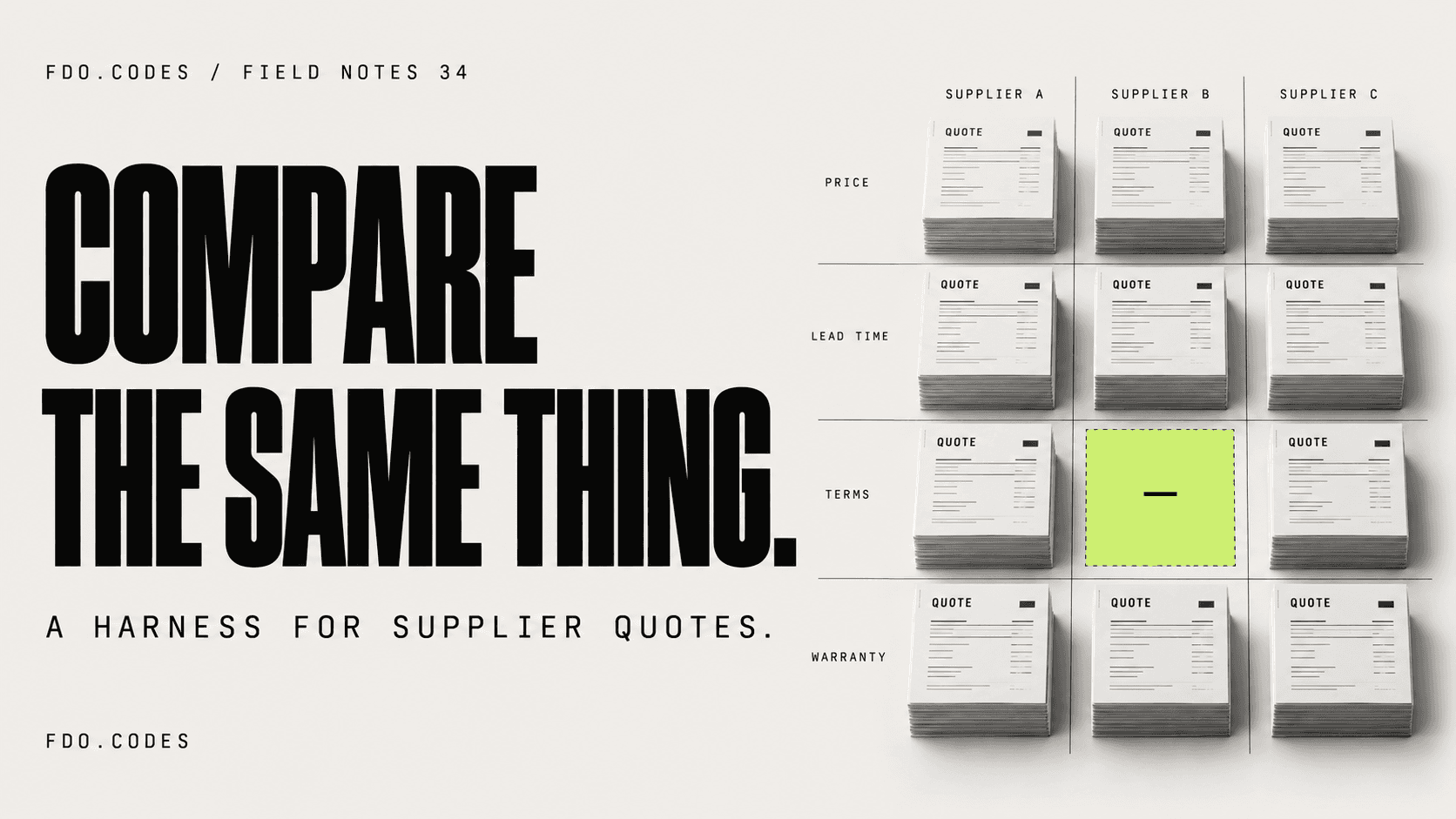
Choose the fields with the person who will make the decision: supplier, item, quantity, unit, currency, net price, delivery cost, lead time, exclusions, quote expiry and source reference. Keep missing values empty and give them an explicit “not supplied” status.
A quote for 100 units must not silently become comparable with one for 10. Likewise, missing delivery cost is not zero delivery cost. Put incompatible units and currencies in an exception column rather than asking the model to guess a conversion.
Assemble a visual workflow
A first no-code design is: upload form → document extraction → structured fields → required-field and consistency checks → comparison table → review notification. A builder such as n8n can supply visual workflow components; the exact document and storage connectors depend on your systems.
Save the extraction instructions inside the workflow. They still exist, but the user no longer needs to write them for every batch. Use a spreadsheet or deterministic calculation step for arithmetic after a person verifies the relevant commercial assumptions.
n8n documents a Structured Output Parser for schema-shaped output. A schema helps enforce format; it does not prove that extracted prices or terms are correct. Read the parser documentation.
Review differences before ranking
Try three invented quotes: one complete, one missing delivery cost and one with a different unit. The expected behaviour is an honest comparison with exceptions, not a winner on every run.
Keep the original documents beside the table. The buyer decides which exclusions matter and whether clarification is needed. Do not let this first workflow place orders or negotiate terms.
If you want a score, define and approve the weighting outside the model and show the calculation. An unexplained AI ranking makes the process harder to audit.
The repeatable part is the comparison standard: the same fields, checks and decision boundary. Wording may vary, extraction can still fail and a stronger model may sometimes help. Measure field accuracy and review time on representative quotes before claiming savings. A harness is valuable when the reviewer can see what was compared and what is still unknown.