Build a support-answer harness that knows when to stop
Retrieve approved knowledge, draft within policy and route unsupported answers to a person.
A customer asks whether a service supports a particular export format. A general prompt may produce a convincing answer from old information or from assumptions about similar products.
A support-answer harness starts with the company’s approved information and a clear rule for what happens when the answer is missing. The first useful version can produce drafts for a support agent without sending anything to the customer.
Give the workflow an approved knowledge boundary
Select a small, maintained set of support articles. Record their versions or update dates. The workflow should retrieve material the current user is permitted to see, rather than searching every internal document indiscriminately.
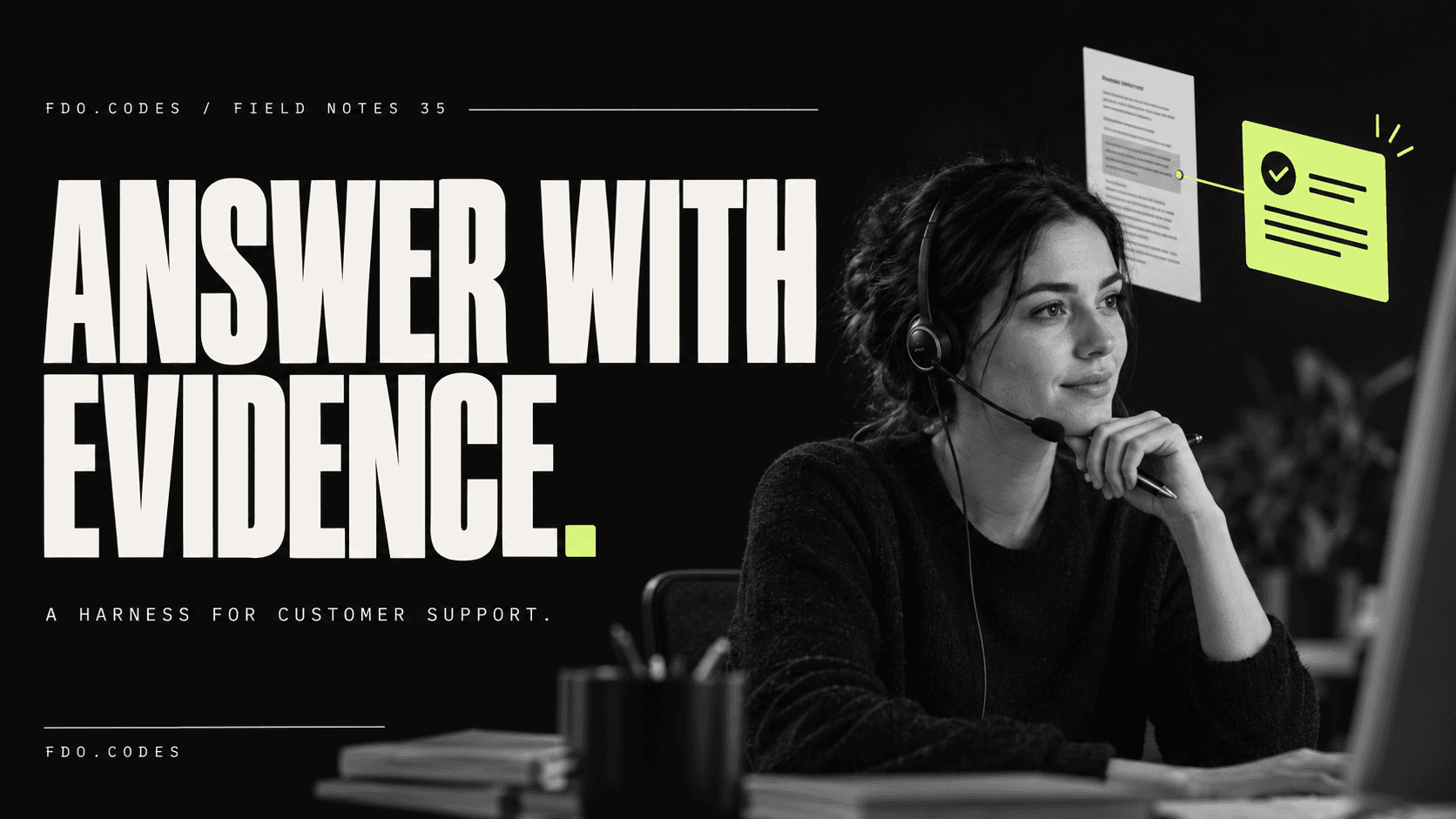
Request a draft answer, supporting source references and an “answer supported / needs review” status. Do not treat a model-generated confidence percentage as proof. The reviewer should be able to open the source and verify the actual claim.
If the sources conflict or omit the requested feature, the useful outcome is an escalation with the unanswered question.
Build the path in a visual tool
A practical sequence is: new ticket → select relevant approved articles → draft response → check required fields and source presence → review queue. Keep customer account actions, refunds and outbound sending as separate capabilities with their own permissions.
Tools such as n8n document human approval around AI tool calls. That can support a deliberate review boundary when a workflow is ready to act. Read the human-review documentation.
No-code still needs setup: connectors, access controls, retrieval configuration, saved instructions and test cases. The benefit is a reusable process, not the absence of engineering decisions.
Test the questions you cannot answer
Build a small evaluation set with a known answer, an outdated feature, conflicting documents and a request outside policy. Include a ticket that contains instructions telling the assistant to ignore its rules. Customer text is material to handle, not authority to expand permissions.
For each case, decide in advance whether a draft or an escalation is correct. Track unsupported claims, unnecessary escalations and the time an agent spends reviewing the result.
A citation can still point to text that does not support the answer. Check that relationship during evaluation instead of accepting source links as decoration.
My target would be a support agent who can verify a useful draft quickly and see why another case was held. The harness should make it easier to be correct and easier to stop when the evidence runs out. It cannot guarantee that every generated sentence is true.