Build a Five-Year AI Budget That Can Change
Plan for durable capabilities, fund delivery in stages and revisit assumptions as the economics and use cases change.
A five-year AI budget should explain what the organisation intends to become capable of doing. It should also make clear which assumptions are still uncertain.
Committing to today’s model mix, usage pattern and supplier pricing for five years would create false precision. I would keep the strategic direction longer term and review the delivery portfolio and operating assumptions much more frequently.
Budget for the complete service
The model bill is one component. A useful plan also includes discovery, data preparation, integration, evaluation, security, staff training, human review, support and eventual migration or retirement.
Separate initial delivery costs from recurring operation. Then give each use case an owner and an allocation method for shared infrastructure. This helps finance distinguish a successful service growing with demand from an inefficient workflow generating avoidable retries.
FinOps guidance makes a useful distinction between resource measures, such as token cost, and business measures, such as cost per case resolved. Both can help explain spending. Read the FinOps unit economics guidance.
Use scenarios and staged commitments
For the first year, fund a small portfolio with explicit evidence gates. Establish a baseline, test a bounded workflow and expand only when quality, operational readiness and value justify it.
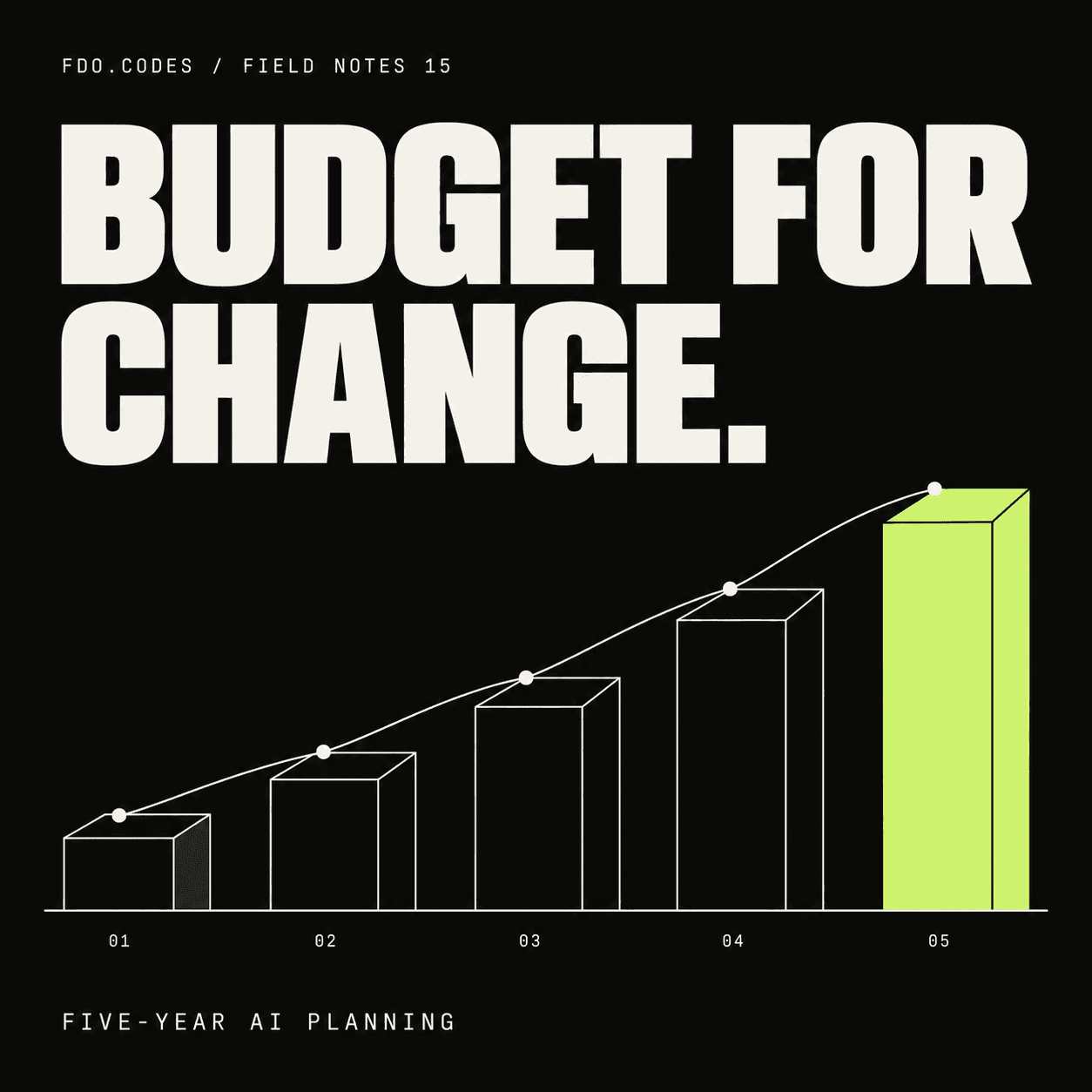
For years two and three, plan options for shared capabilities: identity, approved integrations, evaluation infrastructure and team enablement. For years four and five, state the business capabilities you want and the assumptions that would change the investment. These are planning horizons, not a prediction of how fast every company will mature.
Build conservative, expected and high-demand scenarios. Change several variables: task volume, model choice, review time, failure rate and integration maintenance. A lower inference price may be offset by more usage or more expensive review.
Give saved capacity a destination
Time saved becomes useful when the organisation decides what to do with it. Faster turnaround, better service and reduced backlogs can all matter. They should be measured separately from cash savings.
Do not count the same hour twice across overlapping automations. Do not assume every released hour reduces payroll. Include the time spent checking and correcting the result.
At the next budget meeting, ask for a one-page investment case per workflow: baseline, full operating cost, expected benefit, uncertainty range and a date for the next decision. That is a budget leadership can steer.