Revisit Your Strategy Where the Work Has Changed
Use AI capability changes to revisit specific business assumptions, with evidence from the workflow and a clear route to adoption.
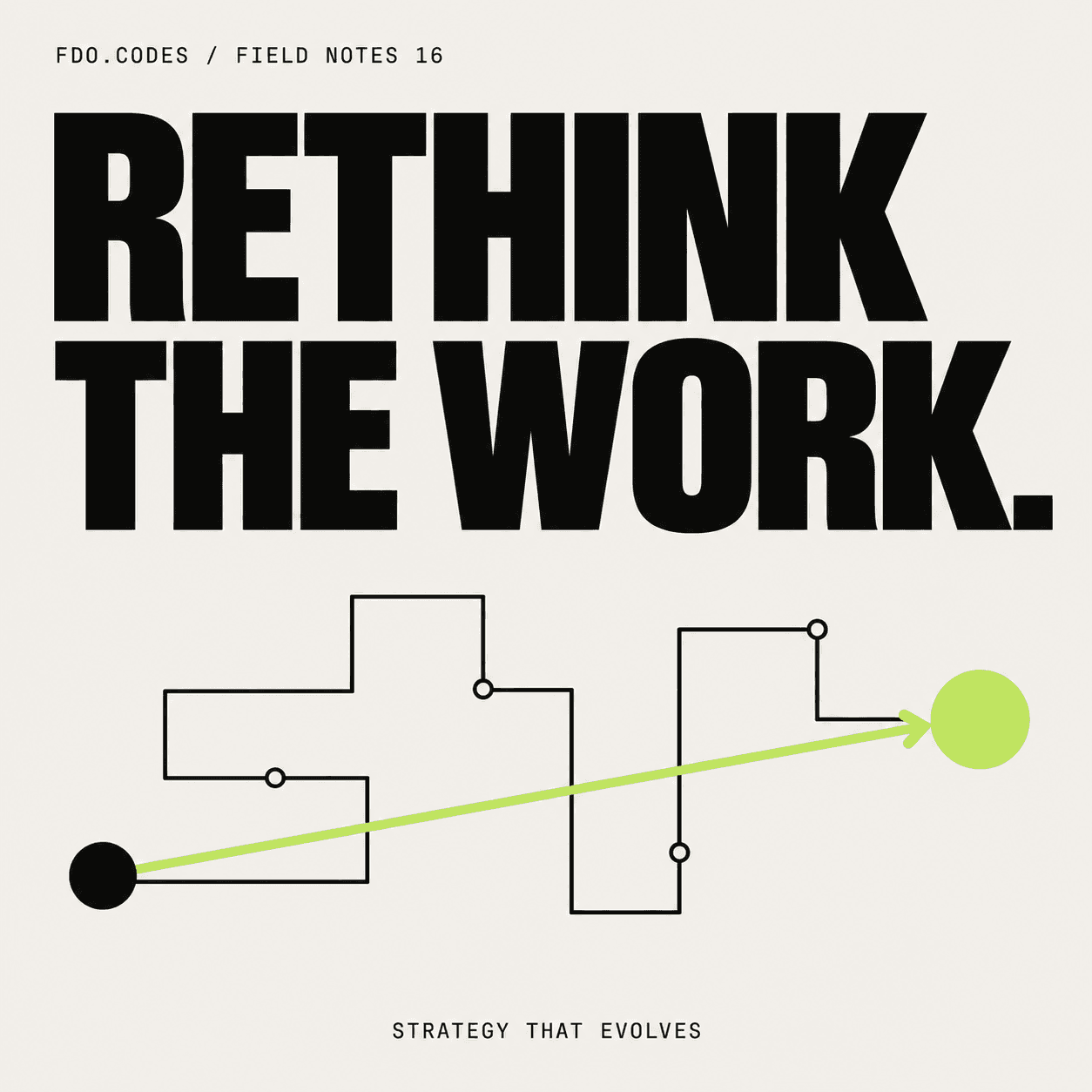
An existing technology strategy can remain directionally sound while some of its delivery assumptions become outdated. AI may change how a task is performed, who reviews it and which integrations are worth building.
The useful response is a targeted review of the work. Look for assumptions that can now be tested more cheaply or challenged by a different architecture. Keep the business outcome visible throughout.
Find the constraint in the real workflow
Start at the desk where the delay occurs. Ask someone to show the last difficult case, including the documents, systems and decisions involved. A polished process diagram rarely captures every workaround.
AI may help interpret unstructured material or prepare an initial draft. It cannot resolve missing authority, unclear policy or unavailable data simply by generating an answer. Sometimes the best first change is a cleaner handoff, a better interface or ordinary automation.
For each candidate, record the current constraint and the evidence that an AI component would improve it. This prevents a strategy refresh from becoming a list of tools to purchase.
Reassess the choices that became cheaper to test
An illustrative internal service might move from manual triage to assisted classification, with uncertain cases still routed to a person. The experiment should measure end-to-end handling time, misrouting, review effort and downstream impact.
Keep a simple baseline in the comparison. A rules-based route may be sufficient for common cases, while a model handles a narrower ambiguous subset. Architectural choice should follow the work and its consequences.
I would also revisit build-versus-buy assumptions. Include configuration, integration, governance and switching effort in both options. A rapid prototype is useful evidence about feasibility; it is not the full operating cost.
Refresh the decision rhythm
Give the strategy a quarterly review: which assumptions changed, which pilots produced evidence, which services are ready to expand, and which should stop? Preserve the longer-term purpose while allowing delivery choices to change.
FinOps describes technology value as a shared responsibility across engineering, finance and business teams. That collaboration is equally useful when deciding where AI belongs in a transformation portfolio. Read the FinOps framework.
My role in embedded delivery is to turn a broad ambition into a practical experiment, then connect the result to architecture and adoption decisions.
Choose one expensive handoff this week. Observe it, establish a baseline and define the smallest credible test.