Build the prototype around the question you need answered
Agentic development can accelerate learning when the product slice and production gap are explicit.
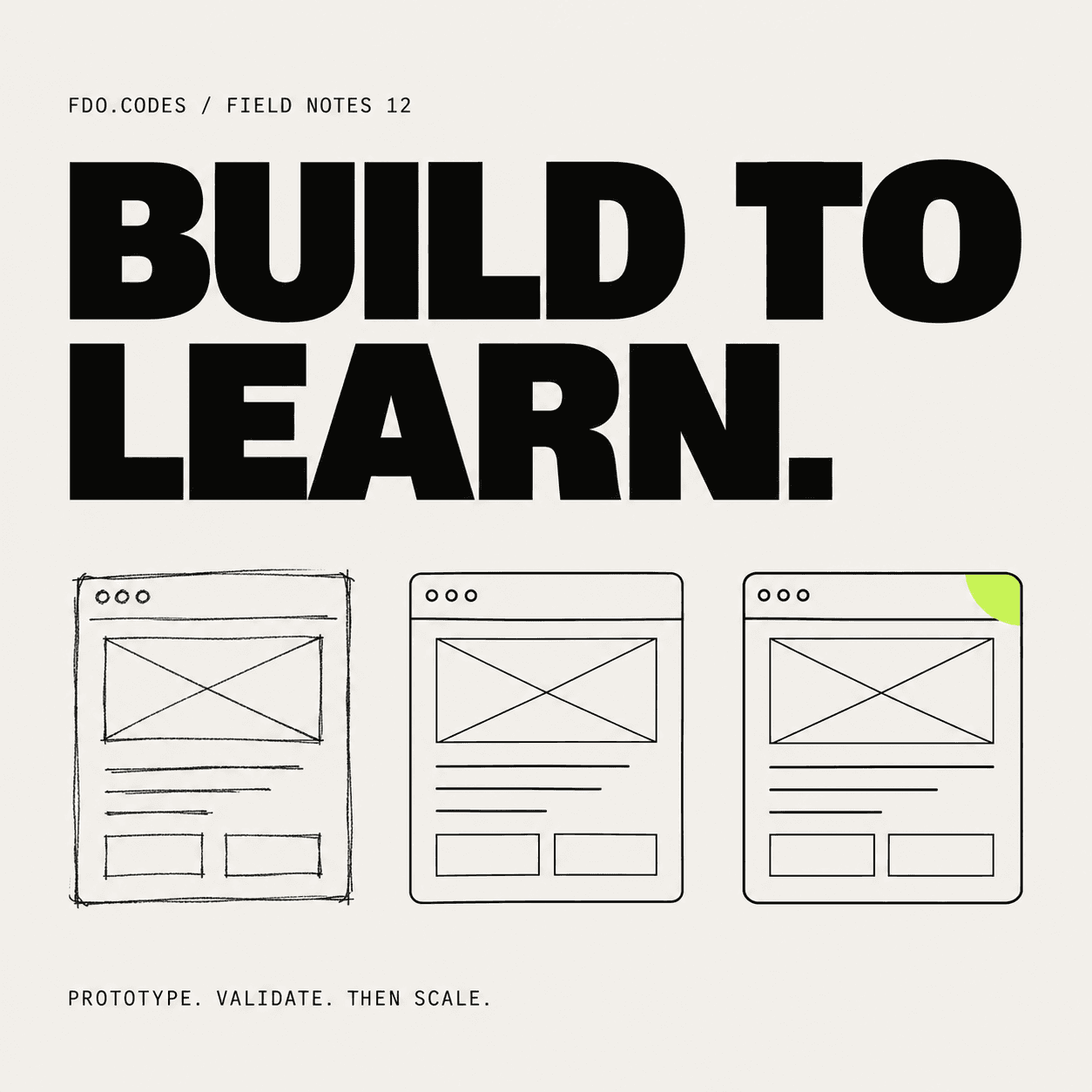
A startup does not need every feature to discover whether an idea is useful. It needs the smallest credible experience that lets the right people test the most important assumption. AI coding pipelines can help build that experience, provided the team is clear about what it is trying to learn.
Define the assumption to test
I would start with one sentence: “We believe this user will use this capability to achieve this result.” Then I would ask what evidence would change our minds. That gives the prototype a purpose beyond demonstrating that we can generate an interface quickly.
Consider an illustrative project-management assistant that turns a meeting into a draft action list. The first slice could accept a sample transcript, propose owners and deadlines, and let a user correct the result before anything is written to a live project. The product question is whether that review experience saves useful effort and preserves trust.
That is enough to test several assumptions. Can users recognise unsupported suggestions? Do they want a separate tool or an integration? Is the action list valuable, or is the real pain following up a week later? Building a large autonomous planning system first could automate the wrong experience.
Build a focused learning loop
My proposed prototype pipeline connects a short brief, a small architecture decision, agent-assisted implementation and a repeatable demonstration. Human review remains responsible for product behaviour and the change. Test data should be suitable for the environment; a prototype is not permission to copy sensitive production data wherever the tools happen to run.
Speed also requires an honest label. A visual prototype, functional pilot and production service are different deliverables. A polished screen does not establish access control, resilience, supportability or sustainable operating cost. I would make the production gap visible before a client decides to scale.
Expand when evidence supports it
The next investment should follow evidence. If the pilot is useful, extend deliberately: authentication, permissions, integrations, telemetry, failure handling, deployment and ownership. Keep the useful product slice working while making those foundations stronger. If the idea is weak, preserve the learning and stop before a larger build makes it emotionally harder to change direction.
For founders, I offer product and technical judgement alongside implementation. For development teams, I can establish the agentic workflow that turns a validated slice into a maintainable product. The aim is a shorter route to an informed market decision, with a credible path from prototype to the system customers will rely on.
That route can be fast without promising an arbitrary launch date before understanding the scope. Speed comes from choosing the right slice, shortening feedback loops and avoiding work that does not answer the current question.
Startup Prototype & Pilot combines a focused build with a clear validation and production decision. hi@fdo.codes