EU data residency and EU inference are different questions
A European storage location is one part of the architecture, not a complete answer about processing.
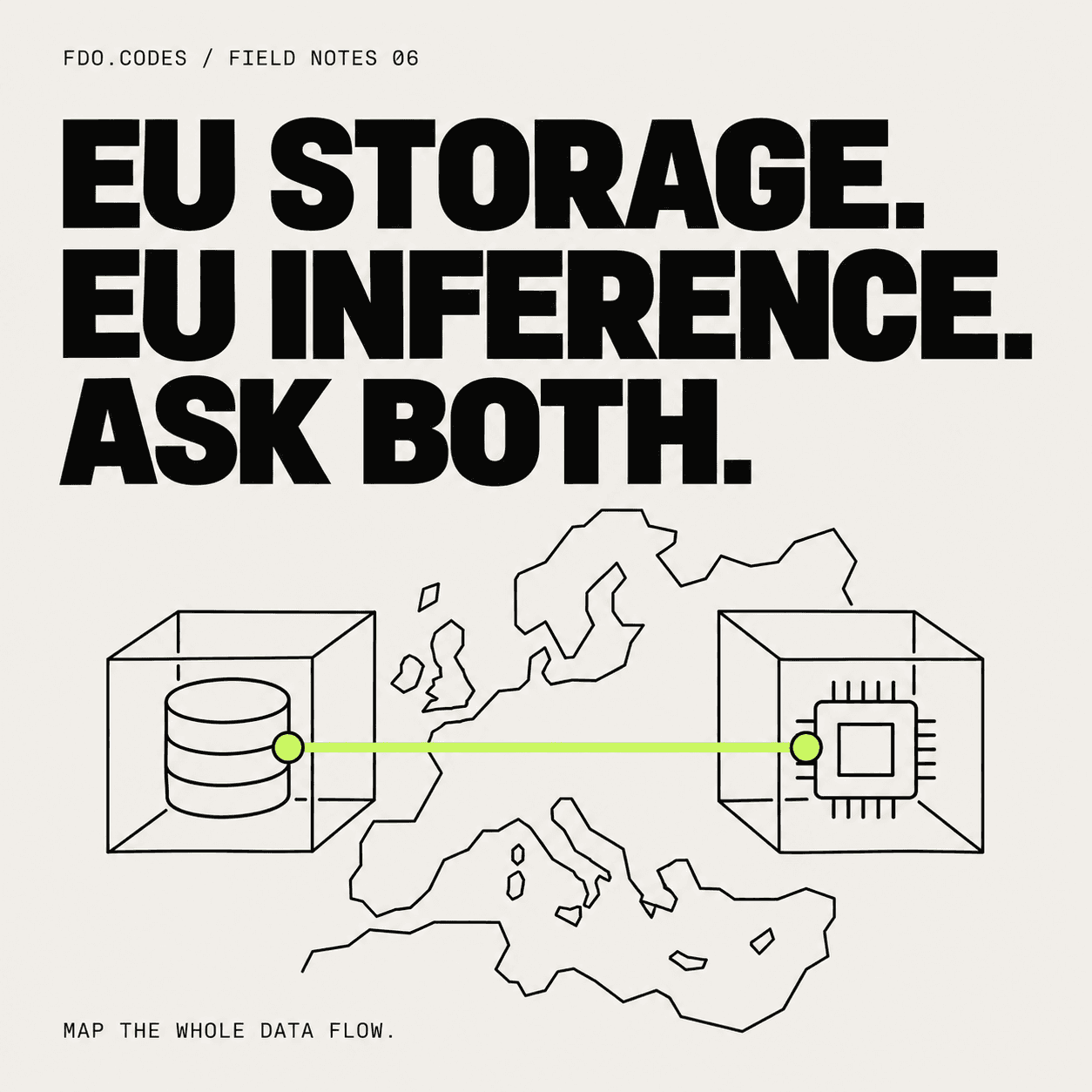
“Our data is in Europe” sounds reassuring. Before approving an AI pipeline, I would ask what that statement covers. The application database, model processing, embeddings, uploaded files, backups, logs, support access and external tools can follow different paths.
Separate storage from processing
Data residency commonly describes where specified data is stored. Inference location describes where the model processes a request. Providers may package these commitments together, but the exact product, deployment type, feature and contract matter. A resource created in an EU region does not, by itself, establish the location of every processing step.
Microsoft’s current documentation makes this distinction explicit for Foundry Models sold by Azure. Global deployments can process prompts and responses across supported geographies, while EU DataZone deployments constrain that processing to EU member nations. Specified stored data remains in the customer-designated geography for both types. These are deployment-specific statements, not a promise about every service carrying the Microsoft name. Microsoft — Data, privacy and security for Foundry Models sold by Azure
AWS likewise distinguishes geographic inference routing from global routing. Its geographic cross-Region documentation notes that prompts and results can leave the source region while remaining inside the selected geography. It also describes model-dependent abuse-detection storage in a destination region. An EU geography is therefore different from a promise to stay in one EU country. AWS — Geographic cross-Region inference
Map the complete data flow
My engineering review starts with a data-flow map. For every component, I record what enters it, where processing occurs, what is retained, who can access it and how deletion works. I include the less visible components: a tracing service, a document parser, a search API and an agent’s browser tool. A correctly configured model endpoint cannot govern a separate tool’s data handling.
Location is also distinct from training use, retention, encryption and control of encryption keys. “Not used to train” does not mean “never stored.” “EU-hosted” does not automatically mean compliance. These questions need separate answers.
Access and accountability matter too
The EDPB’s transfer guidance illustrates another distinction: remote access by a separate processor in a third country can be an international transfer even when data stays stored in the EU. It separately explains why access by an employee of the same controller is not automatically such a transfer. EDPB — Guidelines 05/2021, final version, examples 8 and 11 GDPR also provides mechanisms for lawful transfers; it is not a blanket EU-only hosting rule. EDPB — Standard contractual clauses
I would bring this map to the organisation’s privacy and security owners before a production commitment. Their assessment may include lawful basis, minimisation, contracts, transfer arrangements and any required impact assessment. My contribution is to make the technical facts and viable architecture choices clear enough for that decision.
This work can unblock a pipeline. A vague objection about “European data” becomes a precise requirement: these data classes, these permitted regions, these tools and these retention rules. Then the team can compare real options, including availability, performance and operating cost.
I help teams map AI deployment boundaries and compare workable architectures with their privacy and security owners. hi@fdo.codes