Your coding agent needs a delivery system
Repository context, bounded tasks and release evidence matter as much as code generation speed.
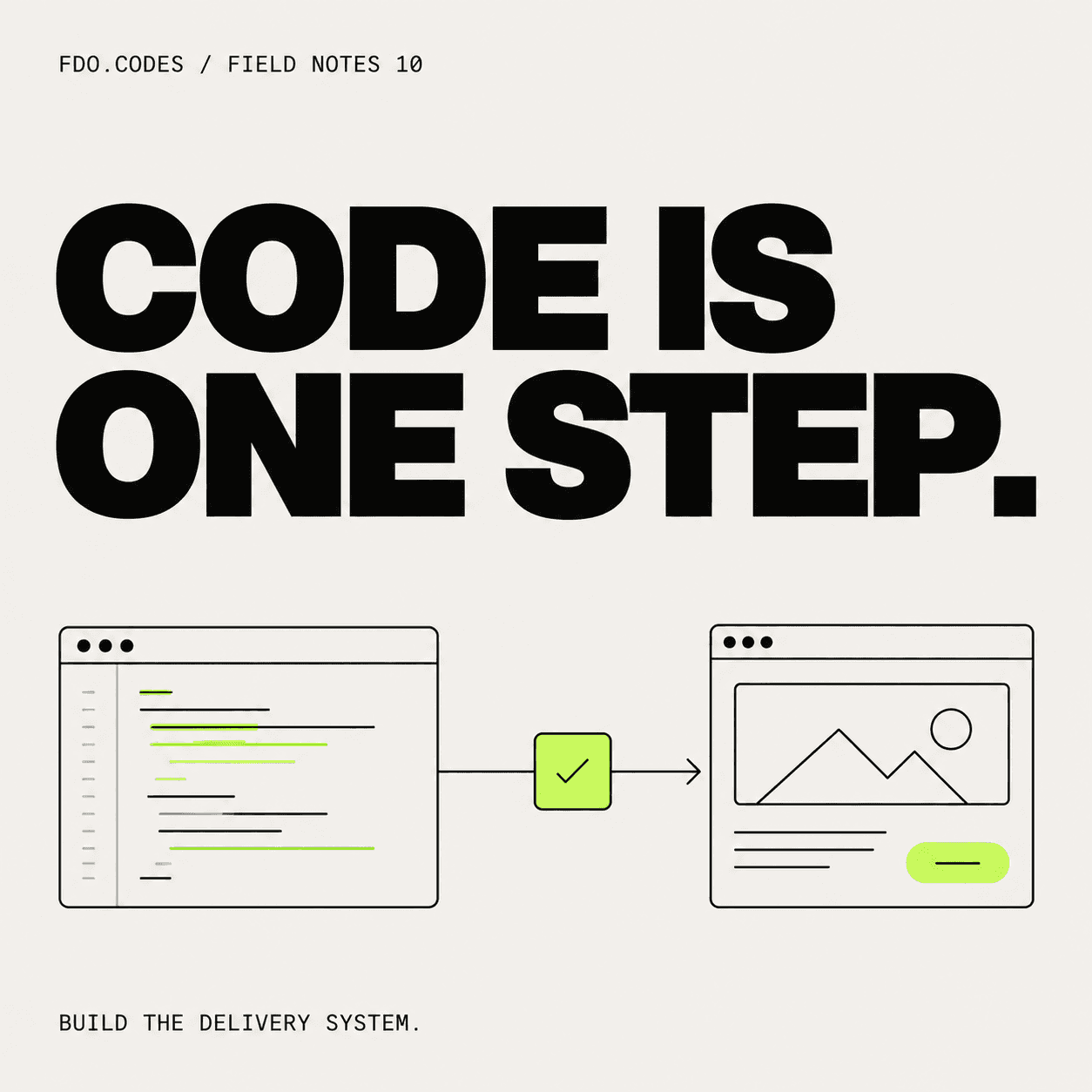
Generating code is one part of delivering software. A client still needs a useful product, a maintainable codebase and confidence that a release does what it is supposed to do. My interest in agentic coding is the complete delivery pipeline around the agent.
My current team uses an agentic coding workflow I created. The broader service I want to bring to clients is a repeatable engineering approach that helps teams build with agents while keeping architecture, review and delivery ownership clear. The workflow must fit the product and the team; installing the same tool everywhere is not enough.
Make the repository and task legible
For a new engagement, I would first make the repository legible. The agent needs a reliable way to understand the architecture, run relevant checks, locate the part it should change and identify constraints. Instructions should be short enough to use, specific enough to matter and maintained alongside the code.
Then I would define a bounded unit of work. “Build the whole platform” leaves too many decisions implicit. “Implement this user journey, with these acceptance criteria and these existing interfaces” gives both the agent and reviewer something concrete to assess. The task should identify decisions that belong to a person.
Long-running work needs continuity. Anthropic’s harness experiments use explicit progress artifacts and incremental work to address loss of context between sessions. Anthropic — Effective harnesses for long-running agents Its later application-development work also examines separate generation and evaluation responsibilities. Anthropic — Harness design for long-running application development I treat these as patterns to test, not a requirement to add more agents to every repository.
Build an evidence-based delivery flow
My proposed flow is simple: clarify the change, prepare the context, implement a small slice, run meaningful checks, review the diff, verify the user journey, and release through the team’s normal controls. A test result is evidence for a particular behaviour; it does not replace understanding the change.
Where several teams contribute, shared contracts become especially important. Service interfaces, ownership, migration rules and review responsibilities prevent one fast agent from creating work for three other teams. Parallel implementation helps only when changes can be integrated and operated coherently.
Measure accepted changes
I would measure time to an accepted change, escaped defects, review effort and rework. Lines generated and prompts submitted are activity measures. They do not tell a product owner whether delivery improved.
Agents can give a small team more implementation capacity. The harness should convert that capacity into useful releases without quietly accumulating confusion. That includes a handover: documented decisions, a known support path and a team that can change the system after the original builder leaves. Good agentic delivery should increase the team’s capability, not make the codebase understandable only to whoever wrote the first prompt.
AI Engineering Enablement helps development teams establish shared agentic coding and review practices. fdo.codes